
That Pay Rise You’re About to Approve? Read This First
One of the most uncomfortable moments for a business owner isn’t a bad month or a tough customer...
It’s sitting across the table from a good employee, knowing their expenses are rising faster than their pay, and wondering whether saying “yes” to a pay increase today, quietly creates a problem you can’t easily undo tomorrow.
There is a practical way to handle wage increases without blowing your budget or damaging trust.
It doesn’t involve saying yes to everything — or avoiding the conversation altogether.
It starts with a small structural shift most business owners have never been shown.
A few weeks ago, I was running a business owner roundtable with ten business owners. One topic completely lit up the room:
“Should we be increasing wages this year and if so, how do we do it without blowing the budget or upsetting people?”
Every business owner around the table was grappling with the same question. I heard versions of:
“Staff are feeling the pinch and asking for more.”
“Every performance review turns into a pay conversation.”
“If I say yes once, I feel like I’ve opened the door for everyone.”
For some business owners, that pressure becomes so uncomfortable they quietly stop doing performance reviews altogether.
Deep down, they know avoidance isn’t the answer, but without a clear structure, every pay conversation feels personal, emotional, and risky.
Why wage conversations hit differently in small businesses.
Wage decisions feel hard because several realities collide at once:
People are under real cost-of-living pressure.
In a small business, saying no isn’t “the company’s decision.” It’s you, looking someone in the eye
Margins are tight, and permanent wage increases sit on your P&L forever.
When pay conversations happen during performance reviews, everything quickly becomes emotional.
Here’s the simple shift that changes everything:
"Separate the “how you’re doing” conversation from the “what we can afford to pay” conversation."
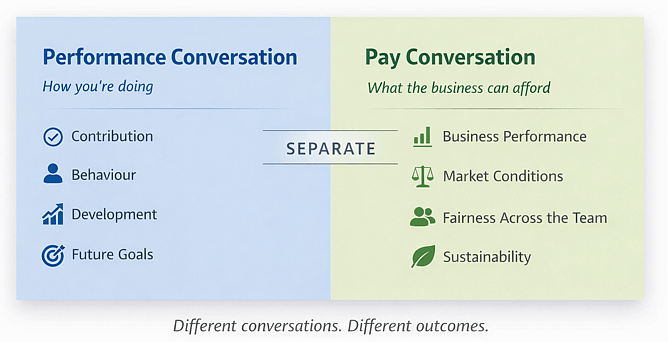
When pay is on the table, it’s all people can think about. They listen for signals, defend themselves, and the real value of feedback is lost.
When pay is not on the table, you can have a far more honest, forward-looking conversation about performance, development, and contribution.
Separating these conversations also gives you the space to make wage decisions based on the full picture i.e business performance, market conditions, and fairness across the team rather than reacting to whoever asked the loudest.
This approach also makes it far easier to say “not yet” without damaging trust or morale.
The simple structure that removes guesswork from pay decisions:
Hold six-monthly performance reviews that focus purely on performance, behaviours, and future goals. Set clear expectations and development actions for the next six months.
Then hold remuneration reviews separately, once or twice a year, at a clearly communicated time. These conversations consider individual performance, overall business affordability, market benchmarks, and internal equity.
If your team doesn’t know the system, you don’t have one.
The crucial part is telling your team the system.
“Performance reviews happen in March and September. Pay reviews happen in July. They’re related, but they’re not the same meeting.”
Once people understand the rhythm, anxiety drops. One-off pay requests reduce, and wage decisions stop feeling emotional or reactive.
How wage conversations stop feeling personal and start feeling fair.
Wage pressure isn’t going away. But when you replace guilt and guesswork with a clear structure, pay conversations stop feeling personal and start feeling fair. If wage decisions are creating tension or avoidance in your business, it’s rarely a people problem.
More often, it’s a system problem and systems can be fixed.
In many cases, a short conversation with an experienced advisor is enough to pressure-test whether your current approach is helping or quietly holding the business back.
Philip Wicks
Co-Founder
BSP Advisory Group


