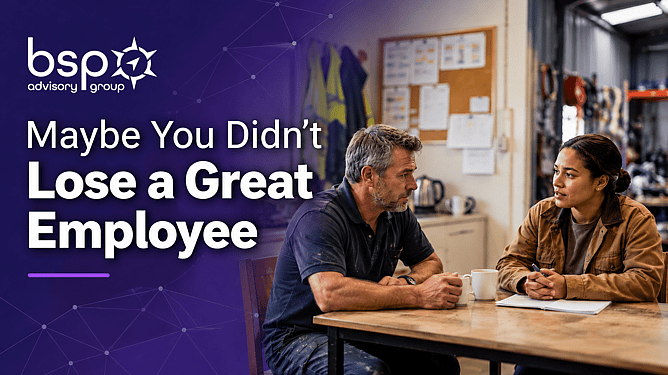
The Coffee That Turned Into Something Deeper
I recently had coffee with a business owner who had just lost one of his key employees.
At first it sounded like a conversation about losing a good employee.
It turned out to be about something much deeper.
It Wasn't the Resignation. It Was the Betrayal He Felt
It wasn't really the resignation that had gotten to him.
He wasn't angry that the employee had decided to move on.
He was hurt.
"I can't believe he'd do this after everything I've done for him," he said, and you could hear the
disappointment sitting underneath it.
He'd trained this person himself.
Trusted him with real responsibility.
Given him opportunities most employers wouldn't.
Watched him grow into someone the business genuinely depended on.
And now he was leaving, and to the owner it felt personal, like a kind of betrayal.
As I listened, one thought kept coming back to me.
When Gratitude Quietly Turns Into Expectation
Somewhere along the way, something changes.
Most business owners are genuinely grateful when they find a great employee. The good ones
are hard to find, they make your life easier, customers trust them, and the whole team leans on
them.
But over time, something subtle shifts.
Gratitude quietly becomes expectation.
Without really noticing it, we start to feel that because we've invested so much in someone,
they somehow owe us the rest of their career.
And that's usually where the hurt begins, not because the employee has done anything wrong,
but because our expectations have quietly changed without us realising it.
Loyalty Was Never Meant to Look Like Ownership
Here's the thing though: Loyalty was never meant to look like ownership.
Good employees don't owe us their future.
They don't have to put our business ahead of their family, or their ambitions, or the
opportunities that come their way.
They're allowed to grow.
They're allowed to want something different, and that doesn't make them disloyal.
Real loyalty is actually much simpler than we make it out to be.
Turn up, do a fair day's work, support your team, treat customers well, be honest,
communicate, and if the day comes to leave, leave professionally.
Forever was never part of the agreement, no matter how much we quietly hoped it might be.
The Businesses That Keep Great People Do Something Different
But here's where it gets interesting, and where the business owners we work with at BSP tend
to think differently.
The businesses that keep great people the longest rarely try to hold onto them through
sentiment or guilt.
Instead, they build something more deliberate.
They identify the senior people who could genuinely run the business day to day, and they give
them real structure around that: clear responsibility, clear expectations, and a genuine reason
to stay and help build something bigger.
Sometimes that means selling a carefully structured equity interest to a senior person who has
earned the trust, responsibility and opportunity to help lead the
business into its next stage of growth.
But equity is not the only answer.
In many owner-managed businesses, a better first step can be a performance- based bonus that
makes the key person think and act more like an owner, without actually becoming one.
At GM or senior leadership level, that might mean a quarterly bonus linked directly to Net
Profit Before Tax or EBITDA, so the key person can see how improved performance flows
through to their reward while the owner retains both the majority of the profit improvement
and the increase in enterprise value.
The right structure is always tailored to the owner, the business, the person, the level of
influence they genuinely have, and the behaviours you want to reinforce.
Because when someone has real skin in the game, whether through equity, profit share, or a
well-designed performance bonus, the conversation changes entirely.
It's no longer about whether they'll stay out of loyalty.
It's about whether they'd walk away from a future they now have a real hand in building.
The Real Risk Isn't Losing People. It's Never Sharing the Business
That's really the deeper lesson underneath the STEP Programme and everything we talk about
with owner dependency.
If your business can't run without you, it's fragile in ways you might not see until someone key
decides to leave.
But if you've built a business where a capable senior person could step in and run it, and where
that person has a real reason to want to because they're respected, challenged, clear on
expectations, and genuinely invested in the outcome, you've solved two problems at once.
You've reduced the owner dependency risk, and you've given your best people something more
powerful than another pay rise: a meaningful role in building something worth staying for.
Maybe You Didn't Lose a Great Employee
Maybe the story with my coffee friend isn't what he first thought.
If someone gives your business eight good years, supports your customers, helps your team,
and makes the business stronger, and then eventually leaves for a genuine opportunity you
never gave them a reason to stay for, perhaps the story isn't that you lost a great employee.
The story is that, for eight years, you had one and there was a moment along the way where
you could have built a better future for both of you.
Perhaps this article has prompted you to think differently about one of your key people, or
about your own role in your business?
If so, track down either Phil or myself and have a conversation.
We call it a Discovery Call, and it costs nothing other than your time.
Have a great week.
Kind regards,
Rob Dorey
Co-Founder | BSP Advisory Group


